About Us

Spring Recharging

In the hilly and mountainous areas water for domestic use (drinking, washing, cooking, etc) is largely derived from shallow wells (Naula) and springs (Dhara). An increasing problem is the deterioration in discharge from springs, which sometimes even causes the springs to dry up entirely. Currently 30% of the springs have almost dried up, and an additional 45% of the springs is on the verge of drying up, affecting approximately 60% of the population in mountainous villages. About 80% of the villages are located near two to three springs, with an average discharge of three to four liter per minute. In Uttarakhand alone 10.000 out of 16.000 villages are burdened with water scarcity and only about 15% can use water for irrigation. As a result of this scarcity, there may be long queues or people may have to resort to collection from another, often distant, source, or collection during the night. Also, there have been reports of conflicts over the distribution of the water.
HESCO’s goal is to increase the discharge of mountain springs that are suffering, and to manage the storage and distribution of the water.
First a site with springs is selected, and then regular discussions are scheduled with the communities to explain the new technology and its advantage. With the consent of the community, the recharge project can be started. The approach consists of data gathering and analyzation:
Water samples are taken from the different springs and are send to BARC in Mumbai for isotope and geochemical analysis
The discharge of springs is measured monthly and additional water samples are send to BARC
Rain gauge stations are installed for the measurement of rain fall data, and rain water samples are sent to BARC
The vegetation is surveyed
To get an indication on the location of recharge areas, the altitude effect may be used to approximate the altitude at which to find a recharge area. It uses the fact that at “higher altitudes, where average temperatures are lower, precipitation will be isotopically depleted compared to the lower altitudes” (Isotope techniques to identify recharge areas of springs for rainwater harvesting in the mountainous region of Gaucher area, Chamoli District, Uttarakhand).
So far 16 springs have already been recharged with the help of BARC (Babha Atomic Research Centre, Mumbai), through the use of artificial recharge structures, used for groundwater augmentation but also for water harvesting. These springs were recharged in Gauchar, dist. Chamoli, and thousands of people are currently benefitting from it. One of these sites is located 200 km from Dehradun, Uttarakhand, in the Himalayas, with a topographic elevation of 700-2100 m (msl). The area contained steep valleys with a rugged surface. The annual average rainfall was 800ml, but the area suffered from major drainage towards the Alaknanda River. In this area HESCO provided a successful implementation of the spring recharging project. This resulted in a substantial increase of discharge for the existing springs, and also resulted in the reappearance of old springs, 100m below subsurface dykes that were constructed. Results are shown in the following tables.
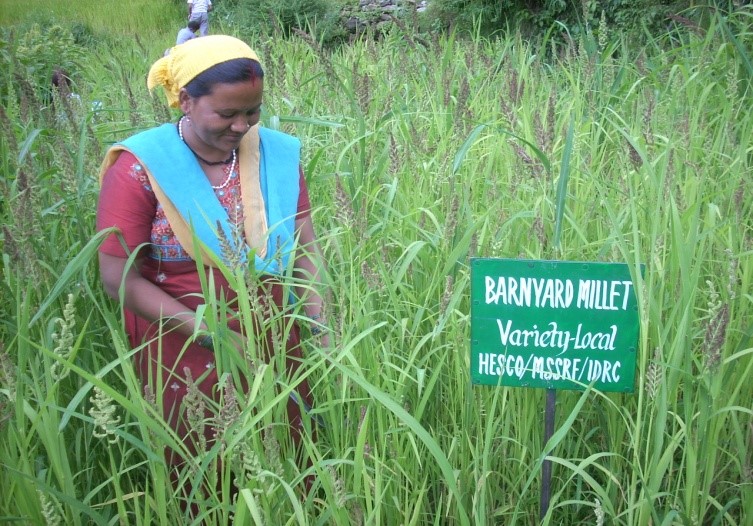
The success of the project is also reflected in the agricultural sector, where yield of wheat, paddy and vegetables increased significantly. The fisheries and animal husbandry where also initiated at commercial level by the villagers.
The success of the project is also reflected in the agricultural sector, where yield of wheat, paddy and vegetables increased significantly. The fisheries and animal husbandry where also initiated at commercial level by the villagers. Seeing that spring recharging projects were such a great success, an additional 10 sites across three states (Uttarakhand, Himachal Pradesh, Jammu & Kashmir) have been selected for spring recharging
The recharging of springs revives ecological niches and retains tradition by providing a decentralized model for water resource management. The springs used by villagers are located above the village, no pumping is needed, so there is no additional cost on pumping s and no maintenance is required.